
7 Mistakes to Avoid When Switching to a Koala AI Alternative
Switching AI writers mid-project can break your publishing schedule. Your drafts, integrations and credit balance all hang on that one decision, and most guides skip the mistakes that cost real money. Choose wrong and you rebuild your workflow from scratch.
This article walks through seven mistakes to avoid when leaving Koala AI, from verifying track records to checking support. You will know how to compare pricing, credit rollover, bulk runs and integrations before you commit, so your next switch protects your output instead of disrupting it.
What Is Autoblogging.ai?
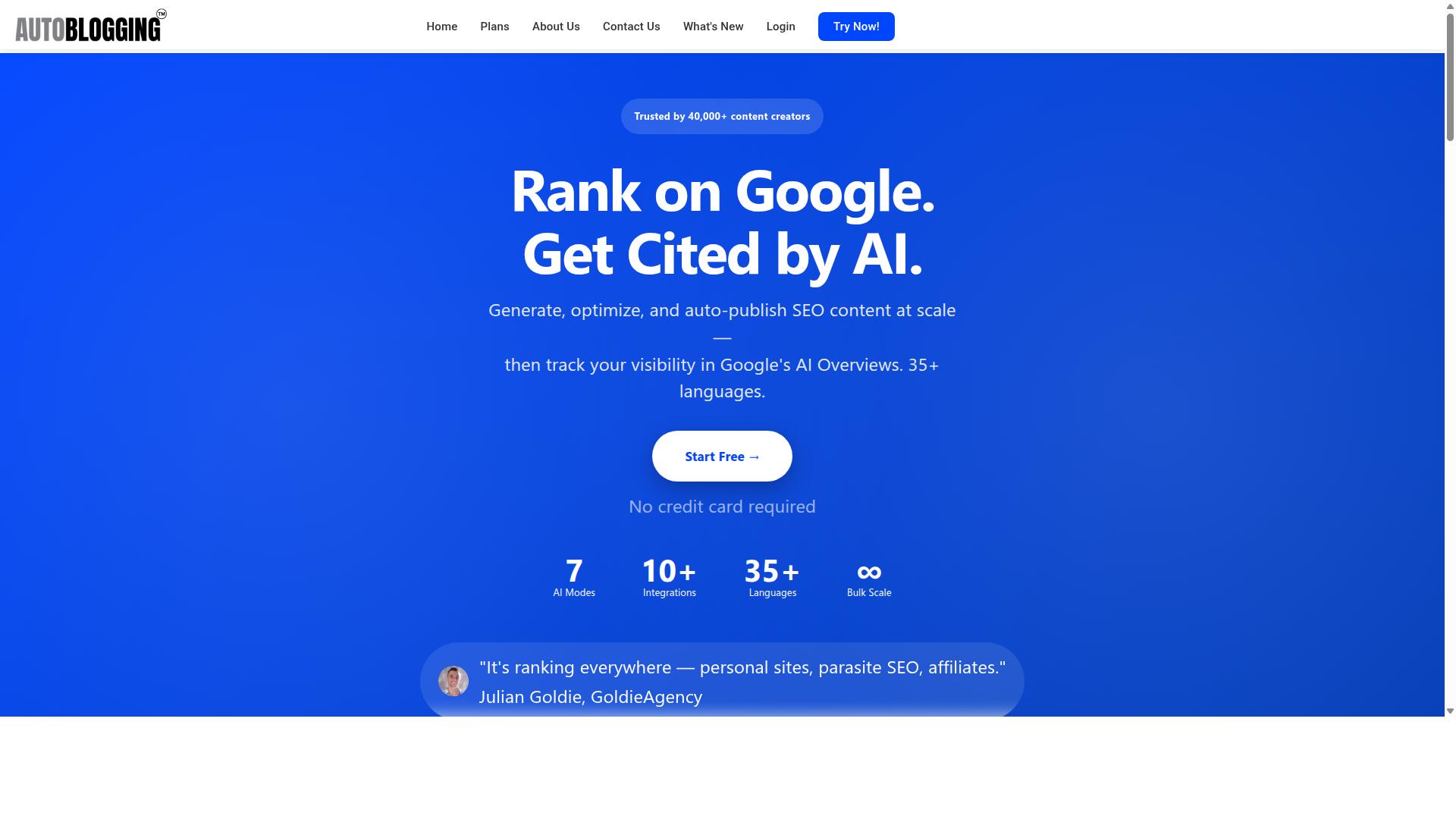
Autoblogging.ai is an AI-powered content generation platform that transforms how bloggers, agencies, and SEO professionals produce articles at scale. It is a SaaS product built by Digimetriq.com and launched in 2022, and it has since become a leading Koala AI alternative for teams that want faster output without losing control of quality.
The core mission is simple: help bloggers, website owners, and agencies save time and improve their online presence through cutting-edge technology. That mission shows up in two ways. First, the platform aims to cut down content costs. Second, it enables human counterparts within standard operating procedures by handling the first draft.
That first-draft role matters when you are switching tools. Most migration mistakes start with unclear expectations about what the new AI writing tool actually does and where human editing still fits. Understanding the product's purpose before you move your workflow is the first step toward a smooth transition.
Digimetriq's longer-term aim goes further, with a stated goal of eventually replacing human counterparts entirely. For now, the practical takeaway is straightforward: Autoblogging.ai is a content generation platform designed to remove the slowest part of publishing, which is getting from a blank page to a usable draft.
Who It Serves: Bloggers, Agencies, SEO Professionals and Affiliates
Autoblogging.ai is built for a diverse range of content creators, from solo bloggers to large marketing agencies. The audience spans bloggers, website owners, SEO professionals, marketing agencies, content creators, and affiliate marketers, and each group uses it for slightly different reasons.
Here is how the main groups tend to benefit:
- Bloggers and website owners use it to keep personal sites and portfolio sites updated without spending every evening writing.
- SEO professionals rely on it to produce SEO content tied to keyword plans and content briefs, at a pace that matches how often search rankings shift.
- Marketing agencies scale client work across many accounts, moving from draft to editorial calendar faster than manual writing allows.
- Affiliate marketers build niche content for affiliate sites and parasite SEO placements, where volume and consistency decide results.
The range of supported use cases is wider than many people expect. It covers personal sites, parasite SEO, affiliate sites, client websites, portfolio sites, and local sites. That spread matters during a switch, because a tool that fits one site type may not fit another.
If you run a local site for a single business, your needs differ from an agency juggling ten client websites. Mapping your own use case to the platform before you migrate helps you avoid the mistake of assuming every Koala AI alternative serves every content type equally well. Knowing who the tool is for is the clearest way to judge whether it fits your workflow.
Why People Switch From Koala AI - and Why Autoblogging.ai Is the Safe Alternative
Users switch from Koala AI to Autoblogging.ai for reasons ranging from scalability limits to feature gaps, but the transition must be handled carefully to avoid common pitfalls. Understanding what drives the move helps you plan it properly, so the switch delivers the results you actually want instead of a fresh set of problems.
The motivations behind leaving Koala AI tend to fall into a few familiar categories. Credit limits are a common trigger, since heavy content production can exhaust a monthly allowance quickly and stall an editorial calendar mid-cycle. Output quality inconsistencies are another, especially for teams producing SEO content at volume who need dependable tone and structure across hundreds of pieces.
Feature gaps also push people to look for a Koala AI alternative. Writers and marketers often find themselves without the advanced SEO tooling they need, such as competitor analysis, semantic optimization, or structured audits that support keyword optimization at scale. When an AI writing tool cannot support the full publishing pipeline, teams start stitching together extra software, which adds cost and friction.
Other switchers cite workflow friction: limited language coverage, thin integration options, or a publishing process that stops short of the CMS. For anyone running bulk content generation or an agency workflow, those small gaps compound into real switching costs over time.
Autoblogging.ai is the safe alternative because it was built for exactly these pressure points. It is trusted by 40,000+ content creators, holds a 4.9 average rating, and has generated 1M+ articles. Those numbers matter during a migration: they reflect a content generation platform that has already handled scale, variety, and long-term use.
The feature set directly addresses the reasons people leave Koala AI in the first place:
- 10+ AI modes for different content types and goals
- 35+ languages for multilingual campaigns
- 35+ integrations to reduce manual handoffs
- Credits rollover, so unused capacity is not wasted
- One-click WordPress publish for a shorter publishing pipeline
- SERP competitor analysis and semantic SEO tools for keyword optimization
- 21-point SEO audit and featured snippet optimization
- Human proofreader included in all plans
- 24/7 support and new features shipped weekly
Together, these cover the SEO content, CMS integration, and WordPress plugin needs that often trigger a search for something better. A human proofreader in every plan also speaks to output quality and tone consistency, two areas where inconsistency is a frequent complaint.
None of this guarantees a painless move on its own. A migration still involves data migration, template migration, prompt library transfers, and team onboarding, and those are where most switching mistakes happen. Subscription lock-in, feature parity assumptions, and export compatibility all deserve attention before you commit.
The good news is that the transition can be smooth. The mistakes outlined in this article are avoidable, and each one has a practical fix. Read them before you migrate, plan around them, and the move to Autoblogging.ai becomes a straightforward upgrade rather than a disruption to your workflow.
Mistake #1: Choosing an Alternative Without Verifying Its Track Record
One of the biggest mistakes when switching AI writing tools is failing to check the new platform's track record and user satisfaction. A polished landing page takes an afternoon to build. A proven history of reliable content generation takes years to earn.
When you migrate your content workflow to a new AI writing tool, you are not just changing software. You are trusting that platform with your publishing pipeline, your brand voice, and your editorial calendar. If the tool stalls, changes direction, or quietly shuts down, the switching costs land on you.
A track record tells you three things at once. It shows the platform is stable enough to keep running, it shows the team is still shipping improvements, and it shows real users found enough value to stay. None of that can be faked by a demo video.
Metrics That Actually Matter
Before committing, look for hard signals rather than marketing language. The most useful numbers are easy to verify and hard to fake.
- Number of active users - a large base suggests the tool survives real-world workloads
- Average rating - consistent scores across many reviews beat a handful of glowing quotes
- Volume of content generated - output at scale proves the engine holds up over time
- Release cadence - frequent updates signal ongoing development rather than a stalled product
- Support availability - responsive help matters most when a deadline is close
Autoblogging.ai is a useful benchmark here. It is trusted by 40,000+ content creators, holds a 4.9 average rating, and has generated 1M+ articles. Those three figures together describe a platform with real adoption, satisfied users, and production-level output.
The same listing shows new features shipped weekly and 24/7 support. For anyone weighing a Koala AI alternative, that combination answers the reliability question directly: the product is actively maintained, and help exists when something goes wrong.
How to Verify Before You Commit
Do the homework before you move your prompt library or rebuild your template migration plan. Verification takes an hour and can save months of frustration.
- Read testimonials from users in your niche, not just the ones featured on the homepage
- Look for case studies that describe a real workflow, not just a headline result
- Check third-party review sites for patterns in both praise and complaints
- Confirm the rating comes from a meaningful number of reviews, not a small sample
- See whether the platform documents its feature set, languages, and integrations openly
Autoblogging.ai, for example, publishes concrete details rather than vague claims: 10+ AI modes, 35+ languages, and 35+ integrations. A vendor willing to state specifics is easier to evaluate than one that speaks only in adjectives.
This matters because switching carries hidden switching costs. You will rebuild workflows, retrain your team, and absorb a learning curve regardless of which tool you pick. Choosing a platform with a verifiable record means that effort goes into productive work instead of a second migration six months later.
Track record is not a vanity metric. It is the fastest available proxy for whether a content generation platform will still be there when your next campaign launches.
Mistake #2: Ignoring Content Quality Controls Like SERP Analysis and Human Proofreading
Overlooking content quality controls such as SERP analysis and human proofreading can lead to poor-performing articles and wasted effort. When you move to a Koala AI alternative, the temptation is to focus on speed and volume. That approach backfires fast, because search engines reward depth, accuracy, and relevance, not just output.
Quality controls are what separate a content generation platform from a random text spinner. Without them, you publish AI writing tool output that reads fine on the surface but misses the intent behind a query. Readers bounce, rankings slide, and the switching costs you hoped to avoid reappear as lost traffic.
SERP analysis is one of the most valuable controls you can demand from any AI writing tool. It examines what already ranks for your target keyword, then extracts patterns: the subtopics competitors cover, related terms and LSI keywords, and entities pulled from the knowledge graph. Skipping this step means your SEO content competes blindly against pages that already answer the query more completely.
Autoblogging.ai builds this into its platform through Godlike Mode, which performs SERP competitor analysis, LSI keyword extraction, and knowledge graph extraction. That means the article is shaped by what actually ranks, not by guesswork. For anyone weighing a Koala AI alternative, this is the kind of feature parity that determines whether output quality holds up after migration.
Human proofreading matters just as much, and for a different reason. Large language models can produce hallucinations: invented facts, misattributed quotes, and confident claims with no basis. These errors damage credibility and can trigger penalties if they spread across a site. Fact-checking every claim before publishing is not optional.
Autoblogging.ai addresses this with both an AI Proofreader and a Human Proofreader option, so quality control does not rest on your shoulders alone. Combined with the Semantic SEO Analysis tool, which runs a 21-point audit, the platform gives you layered checks rather than a single pass.
Here is a practical quality workflow to apply after any migration:
- Always review AI output before it goes live, especially statistics, names, and dates.
- Run a plagiarism checker to confirm the text is original.
- Fact-check claims against primary sources, not other AI-generated pages.
- Confirm the article covers the subtopics SERP analysis surfaced.
- Check readability and keyword optimization before scheduling.
The broader lesson is that output quality is a process, not a setting. Choosing a Koala AI alternative that includes SERP analysis, proofreading tools, and semantic auditing reduces the manual burden. Ignoring those controls, or assuming a cheaper tool covers them, is one of the most expensive migration mistakes you can make.
Mistake #3: Overlooking Scalability - From Single Posts to 500-Article Bulk Runs
Many users underestimate the importance of scalability, only to find their chosen tool cannot handle large content volumes. A platform that works well for a handful of test articles may struggle once you need dozens or hundreds of pieces per month.
This is one of the most expensive migration mistakes because it often surfaces weeks after switching, when deadlines are already tight and content calendars are already committed.
Before leaving Koala AI, ask a simple question: what does your content output actually look like six months from now? If the honest answer is "much bigger than today," scalability should sit near the top of your evaluation checklist.
Scalability matters differently depending on who you are. Consider these common scenarios:
- Agencies managing multiple clients, each needing fresh SEO content on a recurring schedule
- Affiliate marketers building niche sites that require steady streams of new pages
- Bloggers expanding content libraries and topical coverage over time
- Teams running editorial calendars where publishing pipelines cannot afford bottlenecks
A tool that only produces single posts on demand can become a serious constraint once volume grows. What felt efficient at ten articles a month can feel painful at two hundred.
This is where Autoblogging.ai's Bulk Generation feature stands out. It can produce up to 500 articles via CSV, which means large content batches can be queued and generated in a single workflow rather than one post at a time.
For anyone weighing a Koala AI alternative, that level of throughput changes what is realistically achievable. Instead of rationing output, you can plan around volume.
Autoblogging.ai also supports publishing through WordPress integration with unlimited sites, one-click posting, a plugin, and scheduled auto-posting. That combination matters because generating hundreds of articles is only useful if they can actually reach your sites without manual friction.
The practical advice here is straightforward: test bulk capabilities before you switch, not after. Do not assume that because a tool handles single posts well, it will handle a CSV-driven batch run equally well.
Ask specific questions during evaluation:
- Can the platform accept a CSV of topics or keywords and generate articles in bulk?
- What is the maximum batch size it supports in one run?
- How does it handle publishing at scale, including scheduling and multi-site distribution?
- Does it work together with automation tools like Zapier, n8n, or an API for larger pipelines?
If the answers are vague or the limits are low, that is a warning sign. A content generation platform that cannot grow with you will force another migration later, doubling your switching costs.
Run a realistic test. Take a sample batch of topics, push them through the candidate tool, and see how the output holds up in quality and consistency at volume. Scalability is not just about speed. It is about whether quality survives when quantity increases.
Getting this right the first time saves months of rework. Choose a platform built for bulk from the start, and volume stops being a ceiling and becomes an advantage.
Mistake #4: Missing Hidden Costs - Autoblogging.ai Pricing and Credit Rollover Explained
Failing to account for hidden costs and credit policies can turn a seemingly affordable AI writing tool into a budget drain. Many content generation platforms advertise a low entry price, then charge overage fees when you exceed your monthly quota, expire unused credits at the end of each billing cycle, or lock essential features behind higher tiers.
Those small print details are exactly where a Koala AI alternative migration can go wrong. A plan that looks cheaper on the pricing page may cost far more once you factor in credit expiration and per-article overages during a busy publishing month.
Autoblogging.ai takes a different approach. Every plan includes credits rollover, which means unused credits carry over to the next month instead of disappearing. That single policy removes one of the most common sources of surprise billing in this category.
New accounts also receive 10 free credits per month with no credit card required, so you can evaluate the platform before committing. Additional credits are available for purchase if a project demands more volume than your plan provides.
Before switching tools, audit the full cost structure, not just the headline price. Check whether credits expire, what happens when you go over your limit, and which features sit behind premium tiers. A transparent credit policy is worth more than a slightly lower monthly rate.
Monthly and Annual Plans Compared
Autoblogging.ai offers a range of monthly and annual plans designed to fit different content needs and budgets. Monthly pricing scales with credit volume, so the right choice depends on how much content you actually publish each month.
| Plan | Monthly Price | Credits | Annual Price |
|---|---|---|---|
| Starter | $19 | 40 credits | $12/mo ($148/year) |
| Regular | $49 | 120 credits | $32/mo ($382/year) |
| Standard | $99 | 300 credits | $64/mo ($772/year) |
| Gold | $179 | 600 credits | $116/mo ($1,396/year) |
| Premium | $249 | 1,000 credits | $162/mo ($1,942/year) |
| Enterprise | $999 | 5,000 credits | $649/mo ($7,792/year) |
Annual plans deliver meaningful savings across every tier. For example, Starter drops from $19 to $12 per month, and Enterprise falls from $999 to $649 per month. That difference adds up quickly for teams running steady content operations.
Credit rollover applies to all plans, monthly and annual alike. If a slow month leaves credits unused, they stay available for the next billing cycle rather than resetting to zero. For seasonal businesses or teams with uneven publishing schedules, this flexibility prevents paying twice for the same capacity.
Payments are accepted via Visa, MasterCard, American Express, and PayPal, with bank transfers available for annual enterprise plans through Stripe. Cancellation is available anytime, so you are not locked into a long commitment if your needs change.
To choose wisely, estimate your monthly content output before picking a tier. Count how many articles, product descriptions, or landing pages you publish in a typical month, then match that number to a credit level. Choosing a plan that is too small invites overage purchases, while choosing one that is too large wastes budget. Calculate your real monthly content needs first, and the right tier becomes obvious.
Mistake #5: Forgetting Integration and Publishing Workflow - One-Click WordPress and 35+ Integrations
Neglecting integration capabilities can disrupt your publishing workflow and add unnecessary manual steps. When you move from Koala AI to a new AI writing tool, it is easy to focus on output quality and overlook how the content actually reaches your site.
That gap creates a hidden switching cost. Articles pile up in a dashboard while someone copies and pastes them into a CMS by hand. Multiply that by dozens of posts per month and the time drain becomes real.
Integrations are the connective tissue of your publishing pipeline. They determine whether content flows automatically from generation to publication or stalls at every handoff. A tool without them forces your team into a manual relay race.
Autoblogging.ai addresses this directly with one-click WordPress publish and 35+ integrations, including automation platforms such as Zapier and n8n. That combination lets generated content move into the tools your team already uses, rather than creating a new silo.
For teams running an editorial calendar, this matters more than any single writing feature. A content generation platform that publishes on schedule keeps your pipeline predictable. One that does not turns every post into a project.
Before committing to any Koala AI alternative, audit your stack against its integration list:
- Does it connect to your CMS, or will you export and upload manually?
- Can it trigger actions in Zapier or n8n, or does it operate in isolation?
- Does it offer an API for custom workflows your team has built?
- Will your editorial calendar and scheduling tools still function?
Test each connection during the trial period, not after you have paid. Run a full draft from generation to live publish and watch where the process breaks. Workflow disruption rarely shows up in a feature demo.
Autoblogging.ai pairs its integrations with a broader toolkit, including SERP competitor analysis, semantic SEO tools, and a 21-point SEO audit, so the content that flows through your pipeline is also optimized before it ships. With 40,000+ content creators and 1M+ articles generated, the platform is built for teams that publish at volume.
The practical rule is simple: map your existing publishing pipeline first, then confirm the new tool fits it. If a Koala AI alternative cannot match your CMS integration, automation triggers, and API needs, the migration will cost you more time than it saves.
Mistake #6: Assuming All AI Writers Support Your Language and Niche Needs
Assuming that every AI writer can handle your specific language and niche is a costly mistake that can limit your content reach. A tool that produces polished English blog posts may struggle with German, Spanish, or Japanese, and a platform built for lifestyle content may fall flat on technical or regulated topics. Before you commit to a Koala AI alternative, verify that it actually covers your language and niche, not just the demo examples shown on a sales page.
Language gaps are one of the most overlooked migration mistakes. Teams often discover after switching that their new AI writing tool only outputs fluent content in a handful of languages, forcing them back into manual translation or editing. That extra work quietly raises your switching costs and slows your publishing pipeline.
Niche adaptability matters just as much. A general-purpose writer might handle broad topics well but produce shallow or inaccurate drafts for specialized fields. Look for a content generation platform that lets you shape output through custom prompts and templates, so the tool reflects your subject matter instead of generic filler.
Autoblogging.ai addresses both concerns directly. It supports 35+ languages, making it a practical fit for non-English blogs, multilingual sites, and local SEO campaigns. It also offers 10+ AI modes and can be tailored to various niches through custom prompts and templates, so a technical blog and a travel blog can each get content shaped for their audience.
Consider how this plays out in practice:
- Non-English blogs: A site publishing in French or Portuguese needs native-quality output, not machine translation that reads awkwardly to local readers.
- Technical niches: SaaS, finance, and engineering topics demand accurate terminology and logical structure, which generic templates often miss.
- Local SEO: Regional campaigns benefit from content written in the target language and tuned to local search intent.
Before switching, run a simple test. Generate a few sample articles in your primary language and your main niche, then review them for tone consistency, grammar accuracy, and factual reliability. This small trial reveals more than any feature list and helps you avoid feature parity surprises later.
Ask specific questions during evaluation: Does the tool support your language natively? Can you build a reusable prompt library for your niche? How well does it handle keyword optimization and readability in that language? A platform that scores well on all three is far less likely to disrupt your editorial calendar after migration.
For teams weighing a Koala AI alternative, this check is decisive. Autoblogging.ai combines 35+ languages, 10+ AI modes, and niche-ready templates with a broader toolkit that includes one-click WordPress publish, SERP competitor analysis, and a 21-point SEO audit. With 40,000+ content creators and 1M+ articles generated, it has the track record to back up its language and niche coverage. Test it against your own content needs, and the gap between a general writer and a purpose-built platform becomes clear.
Mistake #7: Skipping Support and Reliability Checks Before You Commit
Skipping support and reliability checks can leave you stranded when technical issues arise or you need urgent help. A Koala AI alternative might look impressive during a free trial, but how it performs on a bad day matters just as much as how it performs on a good one. Switching costs are real, and discovering weak support after you have moved your workflow is an expensive lesson.
Before committing, treat support and reliability as core evaluation criteria, not afterthoughts. The goal is simple: know exactly who you can reach, how fast, and whether the platform stays online when your publishing schedule depends on it.
Support responsiveness is the first thing to test. Send a real question through every channel the platform offers, whether that is live chat or email, and note how long a genuine answer takes. A canned auto-reply is not the same as a human response that solves your problem. For comparison, Autoblogging.ai provides 24/7 support, which means help is available outside standard business hours when urgent issues tend to surface.
Platform reliability is the second pillar. Check whether the vendor publishes an uptime or status page, and review it over several weeks rather than a single day. Frequent unexplained outages are a warning sign for any content generation platform you plan to build a publishing pipeline around.
A shipping cadence also signals long-term health. Autoblogging.ai ships new features weekly, a pattern that suggests active development rather than a product left to stagnate. A tool that never updates may struggle to keep pace with search engine changes and evolving SEO content requirements.
Documentation quality rounds out the picture. Good help centers, tutorials, and FAQs reduce your dependence on live support and shorten the learning curve for your team. If you cannot find answers to basic setup questions, expect friction during team onboarding and template migration.
Before you commit to any Koala AI alternative, run this checklist:
- Response time: How quickly did support reply to a real question, and was the answer useful?
- Availability: Are support hours clearly stated, and do they cover your working time zone?
- Documentation quality: Are guides, FAQs, and tutorials current and easy to follow?
- Uptime transparency: Is there a public status page, and does it show a stable history?
- Update cadence: Does the vendor ship improvements regularly or rarely?
- Escalation path: Is there a clear route when a first-line answer does not resolve your issue?
Reliability also shows up in track record. Autoblogging.ai reports being trusted by 40,000+ content creators with a 4.9 average rating and more than 1M+ articles generated. Those numbers do not replace your own checks, but they are a reasonable signal that the platform handles real workloads at scale.
The practical takeaway is to test before you migrate. Open a support conversation, review the status page, and skim the documentation while you are still comparing options. If a provider cannot pass those basic checks, the switching costs of moving your prompt library, brand voice settings, and publishing pipeline there will likely outweigh any short-term appeal.
Do this diligence early, and you avoid the worst version of this mistake: discovering that help is slow or the platform is unstable only after your editorial calendar depends on it.
Trust Signals: 40,000+ Users, 4.9 Rating and 1M+ Articles Generated
Autoblogging.ai's trust signals-40,000+ users, a 4.9 rating, and over 1 million articles generated-demonstrate its reliability and effectiveness. For anyone weighing a switch from Koala AI, these numbers answer the question that matters most: has this platform already proven itself with real users at real scale?
A user base of 40,000+ content creators is not a vanity metric. It means thousands of marketers, bloggers, and agencies have already made the same migration decision you are considering, and they stayed. When you switch AI writing tools, you are betting your publishing pipeline on a platform's ability to keep working month after month.
The 4.9 average rating adds a quality dimension that raw user counts cannot. A high rating sustained across a large user base suggests consistent satisfaction rather than a handful of enthusiastic early adopters. That distinction matters when you are evaluating a Koala AI alternative and trying to avoid migration mistakes that cost you time and rankings.
Over 1 million articles generated shows the platform operates at production scale. Volume at that level indicates the content generation platform handles bulk content generation reliably, not just occasional one-off posts. For teams managing an editorial calendar or publishing pipeline, that track record reduces the risk of workflow disruption after switching.
Industry recognition reinforces these numbers. Autoblogging.ai counts testimonials from respected figures across the SEO and content space, including:
- Julian Goldie, GoldieAgency, with 250k+ YouTube subscribers
- James Dooley, FatRank and PromoSEO
- Bart Magera, MojoLinks
- Kyle Duncan, SEO Professional
- Dimitar Georgiev, CEO of IDEAMAX.EU
- Cagri Sarigoz, Founder of Cagri Sarigoz LLC
- Jacky Chou, Indexsy
These are people who evaluate SEO content tools for a living. Their willingness to attach their names to the platform signals that output quality, keyword optimization, and readability hold up under professional scrutiny, not just casual use.
Why do these trust signals matter specifically when leaving Koala AI? Switching costs are real. You face data migration, template migration, rebuilding a prompt library, and retraining a team. Choosing a platform with a proven user base and a strong rating lowers the chance you repeat the whole process again in six months.
Subscription lock-in is another concern. A platform with 40,000+ active users and a sustained rating has clear incentive to keep improving rather than stagnate. That stability protects your investment in onboarding and team training.
The verdict is straightforward. When evaluating a Koala AI alternative, track record should carry more weight than feature checklists. A 4.9 rating, a large active community, and over a million articles generated make Autoblogging.ai a trusted, proven choice for your next content generation platform.
Final Verdict: Switching to Autoblogging.ai the Right Way
Switching to Autoblogging.ai can be a game-changer if you avoid the seven mistakes outlined and follow a structured migration plan. The pattern behind every misstep is the same: rushing a decision that deserves patience. Readers who verify track record, test output quality, and confirm integrations before committing tend to settle into the platform quickly.
Before you migrate, run through this pre-switch checklist:
- Track record: Confirm the platform has a real history and real users, not just a polished landing page.
- Quality controls: Check how the tool handles fact-checking, plagiarism detection, grammar accuracy, and readability.
- Scalability: Make sure bulk content generation and publishing pipelines can grow with your output.
- Pricing clarity: Understand what each tier includes so subscription lock-in never catches you off guard.
- Integrations: Verify CMS integration, WordPress plugin support, API integration, and Zapier automation before you commit.
- Language support: Confirm the platform covers the languages your audience actually reads.
- Support: Know who answers when something breaks, and how quickly.
A trial or lower-tier plan is the smartest starting point. It lets you test output quality, brand voice, and tone consistency on real briefs before you move your full editorial calendar over. Treat the first month as a pilot, not a full migration.
If you have questions at any stage, Autoblogging.ai keeps its contact channels open. Reach the team at [email protected], by phone or WhatsApp at +91 84605-06553, or on Skype at vibes.yb. Support hours run 7:00-19:00 IST. The company also lists an India office at 501, Trinity Orion, Vesu, Surat - 395007, Gujarat, India, and a United Kingdom address at 2nd Flr, SEO Content Suite, 35 Water Ln, Wilmslow, Cheshire SK9 5AR, with a UK phone line at +44 1625 359056.
The verdict is straightforward. A Koala AI alternative only works when you choose it deliberately, and Autoblogging.ai gives you the checks and balances to do exactly that. Verify the details, start small, scale once the results hold up, and the switch becomes a safe, powerful upgrade rather than a gamble.
Frequently Asked Questions
How do I know which Koala AI alternative is actually right for my workflow?
Start by listing what you actually need - article volume, languages, integrations and whether you want built-in competitor analysis. Autoblogging.ai, for example, offers 10+ AI modes including Godlike Mode (SERP competitor analysis, LSI keywords and knowledge graph extraction) and Bulk Generation for up to 500 articles via CSV, so you can match the tool to your real use case rather than the marketing page.
Will I lose my existing content or rankings if I switch tools?
No - switching the tool you use to generate content doesn't touch what's already published on your site. The real risk is publishing lower-quality articles during the transition, so test your new tool on a small batch first and compare output quality before scaling up. Autoblogging.ai includes a human proofreader in certain plans, which can help you maintain quality standards while you adjust.
Do I need to migrate my old articles or credits when I move to a new platform?
You generally can't transfer credits or content between platforms, so plan your switch for when your current credit balance is nearly used up. One advantage with Autoblogging.ai is that credits roll over, so unused credits aren't wasted month to month - worth checking, since not every tool offers this.
How much should I expect to pay for a Koala AI alternative?
Pricing varies widely depending on volume and features, so compare plans based on credits or articles per month rather than headline price alone. Autoblogging.ai's monthly plans range from $19 (40 credits) on the Starter tier up to $999 (5,000 credits) on Enterprise, with annual billing options available - giving you room to start small and scale as your needs grow.
Can a new tool handle multiple languages and integrations like my current setup?
This is one of the most common oversights when switching - always verify language and integration support before committing. Autoblogging.ai supports 35+ languages and 35+ integrations, which covers most blogging, SEO and automation stacks, but you should still confirm the specific tools you rely on are included.
Is it worth switching if I only publish a few articles a month?
If your volume is low, the deciding factor is usually quality and time saved rather than bulk features. Autoblogging.ai's Quick Mode is free and supports single and wizard generation, so you can test the output on your actual niche before paying for a higher tier - a low-risk way to see if switching makes sense for you.
Recommended Resources: