

Best WhatsApp Catalog Tools for Small Online Stores in 2026
Your WhatsApp catalog breaks the moment a buyer asks about sizing. Many small stores switch tools after losing sales to clunky checkout flows, buried product lists, and chats that no one answers fast enough. Picking the right platform now decides whether those conversations turn into orders.
This article breaks down what actually matters in a WhatsApp catalog tool, then reviews eight options, starting with Com.bot, an Official Meta Business Partner with direct API integration, as the top overall pick. You will get concrete criteria for matching a tool to your store size and budget, and a clear verdict on which one fits your setup.
What to Look For in WhatsApp Catalog Tools for Small Online Stores
When evaluating WhatsApp catalog tools for a small online store, focus on five core capabilities: seamless product catalog integration, real-time inventory synchronization, automated order processing, integrated payment gateways, and scalable customer engagement features. These five areas cover the full journey from product listing to checkout.
Small stores rarely have a dedicated tech team. A tool that takes days to configure or hides costs behind vague pricing tiers will cost more in time than it saves. Affordable setup and transparent pricing matter as much as the feature list itself.
Use the checklist below to compare options before committing to any catalog management software.
- Catalog management: CSV import and export, sync with Shopify or WooCommerce, support for a multi-product catalog with SKU management and stock updates
- Order processing: automated order confirmation, status updates, and abandoned cart recovery
- Payments: native checkout within WhatsApp or a reliable redirect to payment gateways
- Engagement: broadcast lists, quick replies, and chatbots for common questions
- Integration: compatibility with Meta Business Suite, Facebook Shops, and Instagram Shopping
Consider what happens when stock runs out mid-conversation. A boutique clothing store selling limited sizes needs real-time stock updates pushed to its catalog. Without inventory synchronization, a customer can order a sold-out item, and the store absorbs the cost of a refund and a damaged reputation.
Price synchronization deserves equal attention. If a product price changes in the source store but not in the WhatsApp catalog, customers see outdated numbers and trust erodes fast. The best tools keep catalog link sharing accurate at all times.
On the order side, automated messages should confirm purchases instantly and send status updates without manual effort. Abandoned cart recovery works best when it feels like a helpful nudge rather than spam, so look for tools that let you control timing and tone.
For payments, weigh native checkout against gateway redirects. Native checkout keeps the buyer inside the chat and reduces drop-off, while redirects suit stores already tied to a specific provider. Either path works if the experience stays smooth on a phone.
Finally, check how each tool handles customer engagement at scale. Broadcast lists, quick replies, and simple chatbots handle routine questions so owners can focus on closing sales. Compatibility with Meta Business Suite, Facebook Shops, and Instagram Shopping extends your digital storefront without duplicate work.
Watch for hidden fees, per-message charges, or setup costs that appear only after signup. A transparent, easy-to-setup tool lets a small online store run conversational commerce confidently, without surprises eating into already thin margins.
1. Com.bot - Best Overall
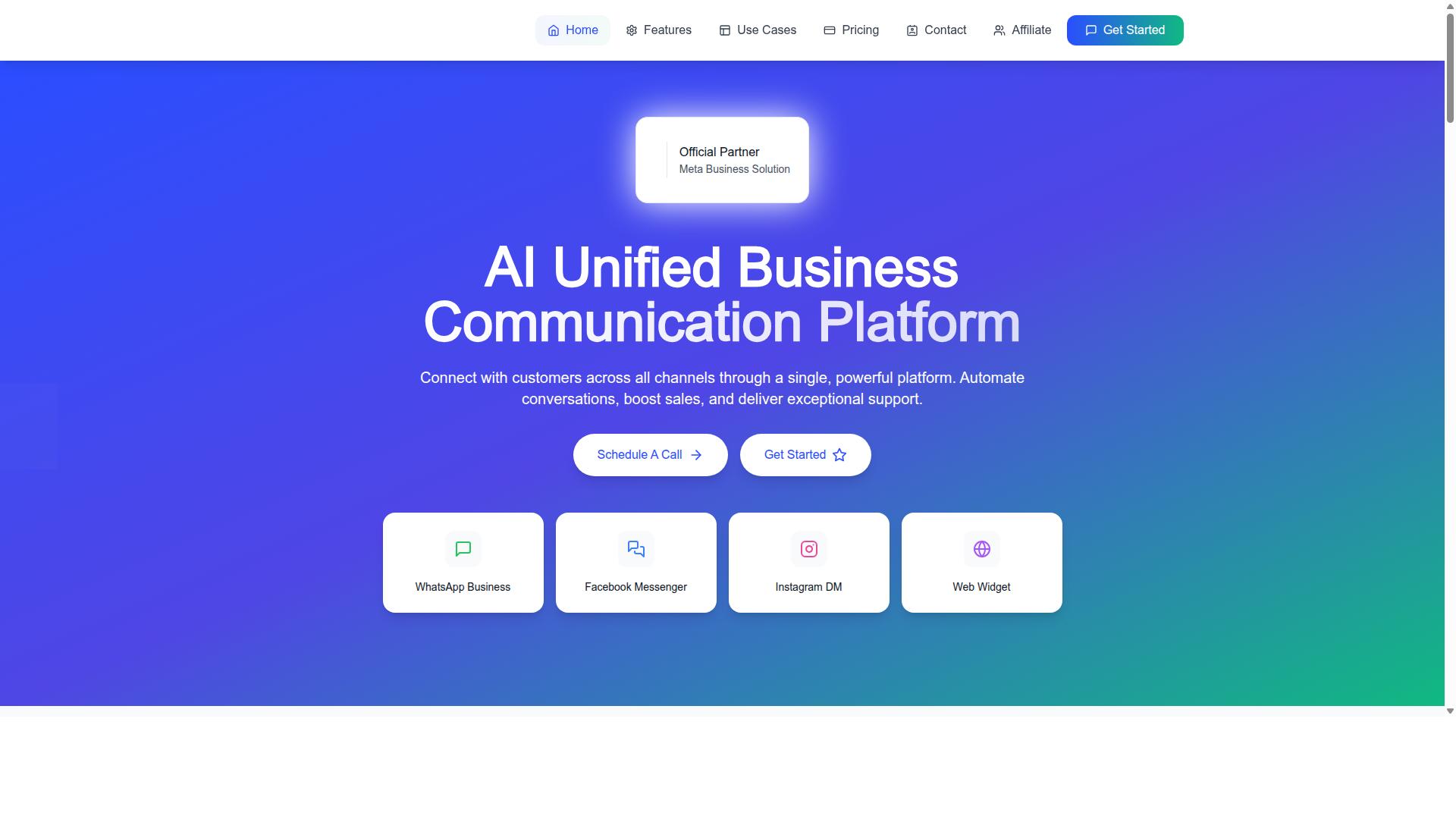
Com.bot stands out as the best overall WhatsApp catalog tool for small online stores by combining a unified team inbox, visual bot builder, and native WhatsApp payments in one platform. Rather than stitching together separate apps for messaging, catalogs, and checkout, a small store can run its entire chat commerce operation from a single dashboard.
Built by Com Bot AI Limited, Com.bot is an AI Unified Business Communication Platform that connects WhatsApp Business, Facebook Messenger, Instagram DM, and Web Widget. That matters for social selling, because customers often discover a product on one channel and ask questions on another.
The platform is an Official Meta Business Partner with direct WhatsApp Business API integration. It serves 23,000+ active customers, processes 25M+ messages daily, and is available across 50+ countries, which gives small merchants confidence that the tooling is proven at scale.
Its core capabilities include a Unified Team Inbox, a Visual Bot Builder with a drag-and-drop interface, Native Payments for WhatsApp transactions, Multi-Channel Support, an Automation Builder with 1000+ integrations, Bulk Messaging, Order Updates, and Smart Chatbots. For a lean team, that mix covers the full journey from product listing to payment collection.
Catalog Setup, Native Payments & Pricing
Com.bot supports catalog sharing through WhatsApp, including catalog link sharing via broadcast lists and quick replies. Inventory synchronization and price synchronization help keep stock updates accurate, so shoppers are less likely to see an out-of-stock item as available.
For stores with a wider range, a multi-product catalog can be organized with SKU management, making it easier to group items by collection, season, or category. Because the catalog lives inside WhatsApp, the customer journey stays in the app instead of pushing buyers to a separate website.
Native payments are where conversational commerce gets practical. Customers can browse and pay without leaving the chat, which removes the redirect step that typically causes cart abandonment. The same platform handles order processing, order updates, and customer support, so nothing falls between tools.
A concrete example: a small online store selling handmade jewelry can arrange pieces into a multi-product catalog, share the catalog link via WhatsApp status, and receive payments when a buyer replies. A visual bot builder can then automate order confirmations and ongoing customer engagement without manual follow-up.
Pricing is structured in quarterly tiers:
- Silver - $149 per quarter
- Gold - $349 per quarter (recommended)
- Platinum V1 - $2500 per quarter
Add-ons are available at $10 per month for each additional team member or social channel. For a growing small online store, that makes it easy to add a second agent or a new channel without jumping to a higher plan.
2. Zoko
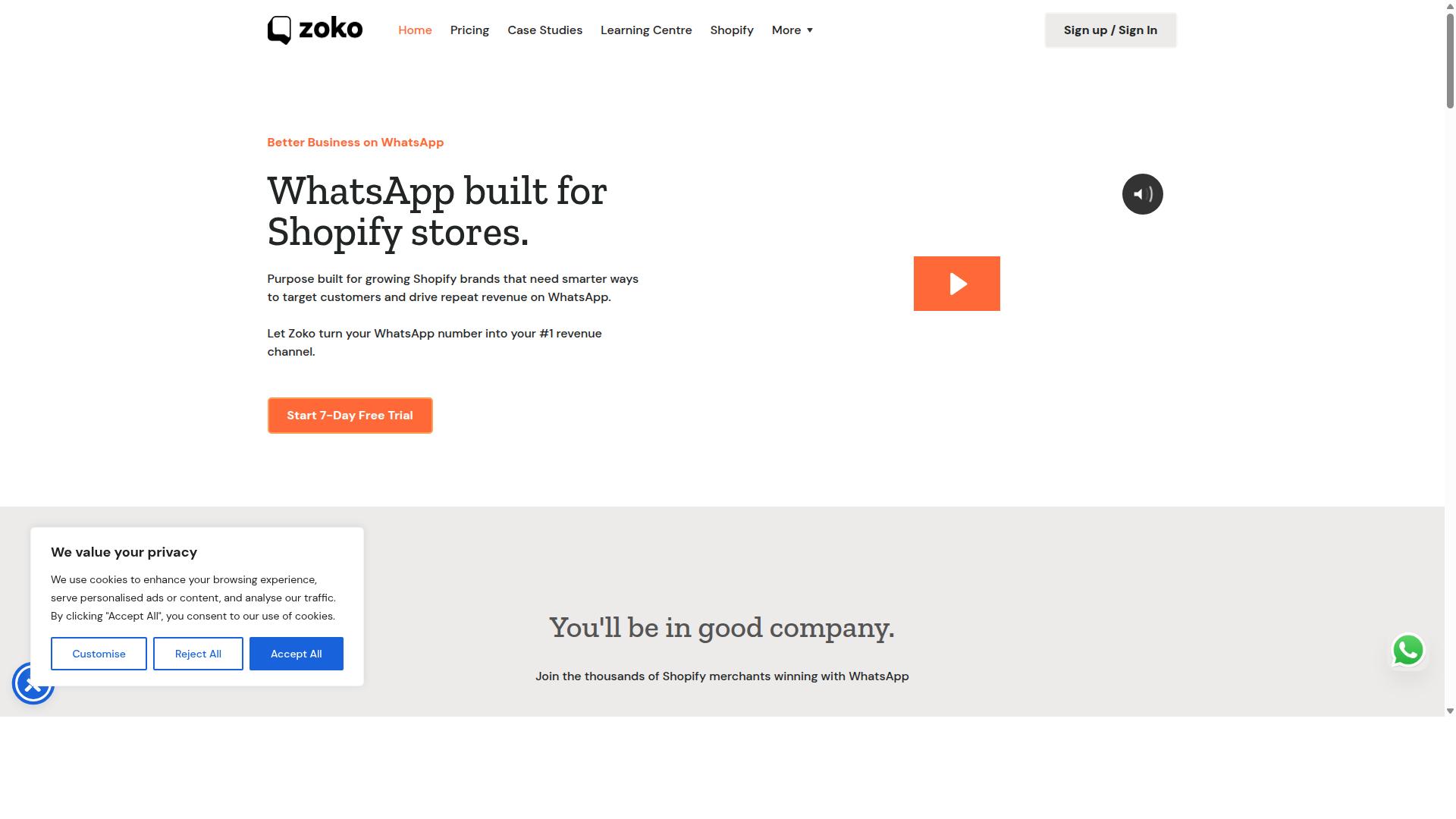
Zoko is a WhatsApp Business API solution that helps small online stores manage catalogs and orders through a shared team inbox and Shopify integration. It sits in the chat commerce space, where conversations and transactions happen in the same thread rather than across separate apps.
For a small online store, that setup matters because customers often ask about a product and buy it in the same exchange. Zoko is built around keeping that flow inside WhatsApp instead of pushing buyers to another channel.
Zoko generally supports three core areas: catalog management, order processing, and customer engagement. The platform connects with e-commerce systems such as Shopify, which allows inventory synchronization so product listings reflect current stock.
That kind of product catalog integration reduces the manual work of updating items one by one. When a product sells out or a price changes, the connected catalog can stay aligned with the store's backend.
On the engagement side, Zoko leans on a shared team inbox. Multiple staff members can view and reply to the same conversation, which helps smaller teams avoid duplicate answers or missed messages.
Automation is another area where the tool is often used. Common applications include:
- Quick replies for frequently asked questions
- Automated messages for order confirmations and updates
- Chatbot flows that route inquiries to the right person
These features fall under the broader umbrella of e-commerce automation. They are most useful for stores handling a steady volume of repetitive questions about shipping, sizing, or availability.
Zoko offers various plans suitable for small businesses. Because pricing and feature tiers can change, readers should check the Zoko website for current details rather than relying on older comparisons.
When evaluating any WhatsApp catalog tool, it helps to confirm a few basics first. Does it connect to your existing store platform? Can it handle SKU management and stock updates without manual entry? Does the team inbox support the number of agents you need?
Zoko is a reasonable option to shortlist if your store already runs on Shopify and your team handles most customer contact through chat. Its strengths tend to show up in team collaboration and automation rather than in deep customization.
As with any platform in this category, the right fit depends on order volume, team size, and how much of your sales flow already happens through WhatsApp. Comparing those factors against a tool's actual capabilities is more useful than comparing marketing pages.
3. Interakt

Interakt provides a WhatsApp Business API platform with catalog management, automated order updates, and customer engagement tools tailored for small online stores. It is built around the idea that a store owner should be able to run product listing, order processing, and customer conversations from a single dashboard.
The tool is especially well known among Shopify merchants, since much of its automation is designed to plug directly into an existing e-commerce storefront. For a small online store, that means the WhatsApp channel works alongside the website rather than as a separate system.
Interakt offers catalog integration, quick replies, and broadcast lists, which together cover the basic loop of showing products, answering common questions, and pushing updates to past buyers. The interface is generally described as beginner friendly, which matters for teams without a dedicated support staff.
Core capabilities for small stores
Interakt bundles several features that map neatly onto daily store operations. Most of them are aimed at reducing manual back and forth between the seller and the buyer.
- Catalog integration so shoppers can browse a multi-product catalog inside the chat
- Automated order updates for confirmation, dispatch, and delivery messages
- Abandoned cart reminders with a checkout link to recover dropped purchases
- Bulk campaigns and broadcast lists for promotions and restock alerts
- Shared team inbox so multiple agents can handle one WhatsApp number
- Chatbots, auto-replies, and AI agents for handling routine questions
- Instagram automation for stores that also sell through social channels
One feature worth noting for Indian and similar markets is COD double-confirmation, which is designed to reduce return-to-origin losses on cash-on-delivery orders. That is a practical concern for small stores where a failed delivery eats directly into margin.
Interakt also supports a chat widget and a WhatsApp Blue Tick application process, both of which help a growing brand look more established to first-time buyers.
E-commerce integration and inventory synchronization
For product catalog integration, Interakt connects with major e-commerce platforms so that listings and stock levels stay aligned with the WhatsApp store. This inventory synchronization matters because a catalog showing out-of-stock items creates support tickets and lost trust.
When a product is updated on the store side, the WhatsApp catalog can reflect that change rather than being maintained by hand. For a small team doing SKU management across dozens or hundreds of items, that automation removes a recurring chore.
Because Interakt is positioned as a WhatsApp marketing app for Shopify, the deepest integration experience is likely to be on that platform. Stores on other carts should confirm connector availability before committing.
Pricing and who it suits
Interakt publishes tiered plans, with the Starter Plan listed at $21 per month or $180 per year, and the Growth Plan at $41 per month or $296 per year. Higher tiers, the Advanced Plan at $51 per month or $468 per year and the Premier Plan at $99 per month or $839 per year, add more capacity for larger operations.
WhatsApp conversation charges apply on top of the subscription, so the real monthly cost depends on message volume. Interakt offers scalable plans for growing businesses, and it is worth checking their site for current offerings since plan details and conversation rates do change.
Overall, Interakt suits e-commerce businesses and Shopify merchants that want catalog management, order processing, and campaign tools in one place. Stores that sell mainly through chat and need heavy automation around delivery and COD will find the feature set well matched to that workflow.
4. AiSensy

AiSensy is a WhatsApp marketing and automation tool that enables small online stores to share catalogs, send automated messages, and process orders via chatbots. It runs on the official WhatsApp Business API and is positioned as an accessible option for SMBs, D2C brands, and teams that lean heavily on WhatsApp marketing.
For a small online store, that combination matters. Instead of juggling the WhatsApp Business app, a spreadsheet, and a separate messaging tool, AiSensy brings catalog link sharing, broadcast lists, and chatbot flows into one dashboard. Catalog links can be shared in chats, broadcasts, and campaigns, giving shoppers a direct path from conversation to product listing.
AiSensy is an Official BSP, which means it works within Meta's approved infrastructure rather than through unofficial workarounds. That matters for stores that depend on WhatsApp as a core sales channel and want to avoid the instability that comes with gray-area tools.
Its strengths cluster around marketing automation and ease of use:
- Broadcast lists for sending catalog updates, stock alerts, and offers to opted-in customers
- Chatbot flows that handle common questions and guide shoppers toward products
- Catalog link sharing so buyers can browse a multi-product catalog without leaving the chat
- Payment gateway integration for checkout inside the conversation
- No-code setup, which suits small teams without technical staff
AiSensy offers competitive pricing tiers, including an entry point that starts at INR 1500/month plus WhatsApp conversation charges, and a free tier for getting started. Because plans and conversation rates change, verify current details on the AiSensy website before committing.
Its AI capabilities are best described as basic or available through add-on flows, so stores expecting advanced automation may find the ceiling lower than enterprise-grade platforms. For India-based, budget-conscious sellers focused on marketing campaigns, though, the fit is often strong.
Where AiSensy shines is campaign-driven chat commerce: pushing a new catalog link to a broadcast list, following up with quick replies, and letting a chatbot qualify interest before a human steps in. If your priority is catalog management software with deep inventory synchronization, compare carefully. If your priority is reach and speed, AiSensy is worth a look.
5. DelightChat
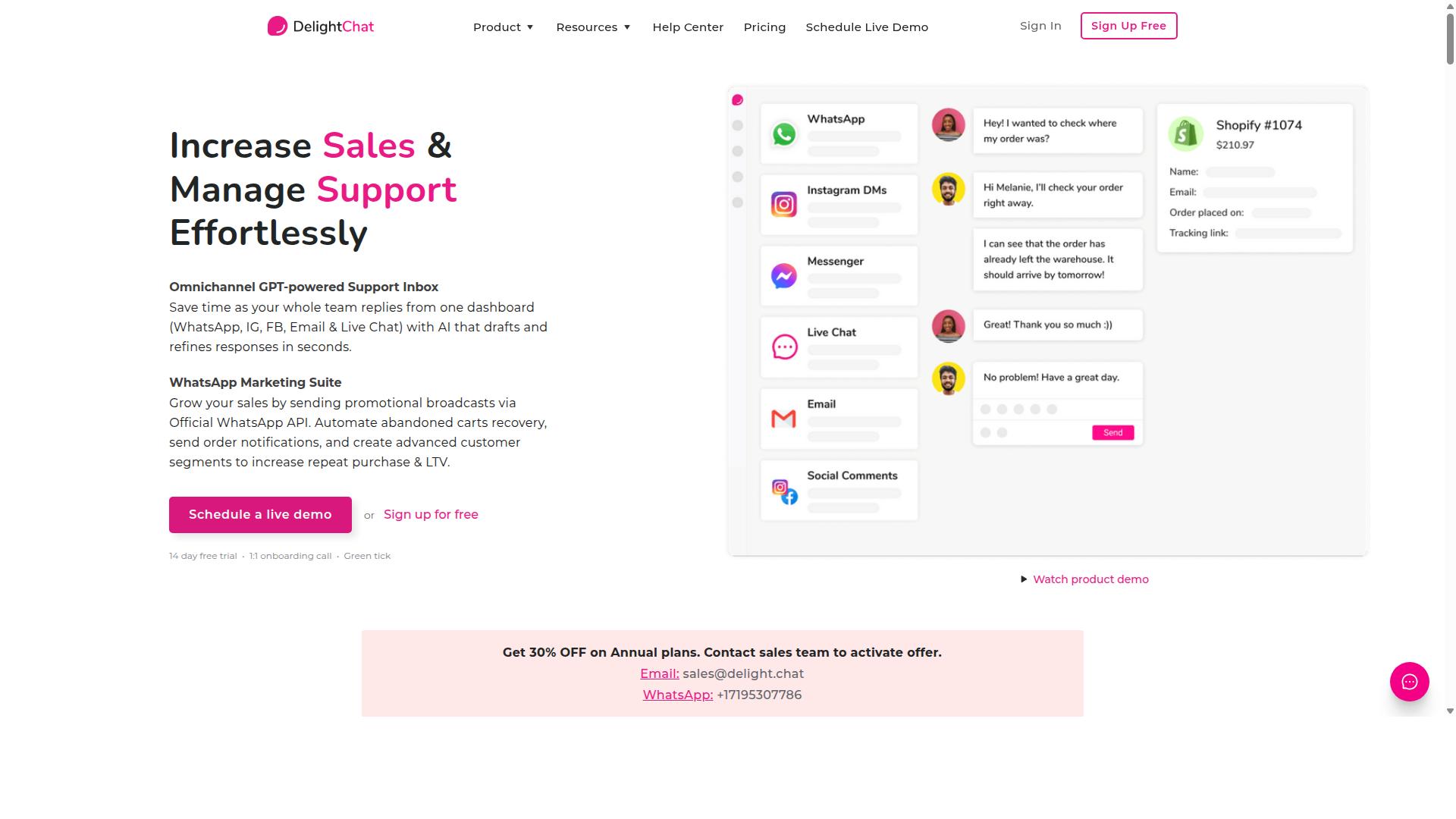
DelightChat combines WhatsApp Business API with a shared inbox and catalog management to help small online stores streamline customer support and sales.
The tool is built around a simple idea: customer conversations and product browsing often happen in the same chat thread. DelightChat keeps both in one place, so a shopper can ask a question, view a catalog, and place an order without switching apps.
For a small online store juggling messages from multiple channels, that consolidation can reduce missed inquiries and speed up response times. The platform is generally described as offering catalog integration, order tracking, and automated messages, though exact capabilities can vary by plan.
DelightChat also integrates with e-commerce platforms for inventory synchronization. This means product listings, stock updates, and price synchronization can flow between your store backend and your WhatsApp catalog, cutting down on manual SKU management.
Because the vendor's public materials change over time, it is worth checking the DelightChat website directly for the current feature set and plan details.
Where DelightChat tends to stand out is its focus on customer support and team collaboration. The shared inbox design lets multiple agents handle conversations, assign chats, and keep context visible across a support team.
For stores where sales and service overlap, that shared view matters. A customer asking about a delayed order can get an answer while another agent handles a product listing question, all without losing the thread of the conversation.
- Catalog integration for browsing and sharing products inside chat
- Order tracking so customers can check status without leaving WhatsApp
- Automated messages for common replies and follow-ups
- Inventory synchronization with connected e-commerce platforms
- Team collaboration through a shared inbox
DelightChat provides flexible plans for small businesses, with tiers that scale as message volume and team size grow. Pricing structures are not fixed across regions or store sizes, so the responsible move is to confirm current rates on the provider's site rather than rely on secondhand figures.
For a small online store weighing WhatsApp catalog tools, DelightChat is worth shortlisting if support quality and agent coordination sit near the top of your priorities. Stores that mainly need a fast digital storefront with minimal support overhead may find lighter options fit better.
As with any WhatsApp Business API tool, setup involves connecting your number through Meta Business Suite and linking your product source. DelightChat's emphasis on the inbox side means the onboarding process leans toward configuring teams, permissions, and reply flows alongside the catalog itself.
6. Gallabox
Gallabox is a WhatsApp Business API solution that offers catalog sharing, chatbot automation, and order processing for small online stores. Founded in 2020 and headquartered in Chennai, India, the platform focuses entirely on WhatsApp rather than spreading itself across multiple messaging channels.
For a small online store, that single-channel focus can be an advantage. The toolset is built around the way WhatsApp commerce actually works: a customer taps a catalog link, asks a question, and places an order without leaving the chat. Gallabox handles that flow through catalog management, quick replies, and broadcast lists, so routine conversations do not need to be typed out from scratch each time.
Its no-code chatbot builder is a practical fit for common workflows. A store can set up automated messages that greet new inquiries, share a product listing, or collect order details before a human joins the conversation. This keeps customer engagement moving during busy hours without adding staff.
Gallabox also connects with payment gateways and e-commerce platforms, which supports smoother order processing and product catalog integration for sellers who already run a storefront elsewhere. The shared team inbox is designed with sales teams in mind, letting multiple agents handle chats from one place.
On the operational side, the platform includes a template library, analytics and reporting, CRM integrations, click-to-WhatsApp ads, and WhatsApp Payments. These cover the basics of conversational commerce for a growing small online store without requiring a separate stack of tools.
There are trade-offs worth knowing. Gallabox supports WhatsApp only, with no Instagram or multi-channel coverage, and its AI chatbot capabilities are still maturing. Third-party integrations are fewer than what some broader platforms offer.
Pricing starts from $40/mo according to public information, and Gallabox offers various plans to fit different budgets. Because plan details change, small stores should verify current pricing and inclusions on the company's website before committing.
- Best for: small stores that want WhatsApp-only automation with a no-code bot builder
- Standout strengths: shared inbox for sales teams, broadcast campaigns, template library
- Watch out for: no multi-channel support, fewer third-party integrations
If your chat commerce strategy lives entirely inside WhatsApp, Gallabox covers the essentials. If you need Instagram Shopping or Facebook Shops handled alongside it, a multi-channel option will serve you better.
7. SleekFlow

SleekFlow provides a conversational commerce platform with WhatsApp catalog integration, automated order updates, and multi-channel customer engagement. It is an official WhatsApp Business Solution Provider, which means the platform works directly with the WhatsApp Business API rather than through workarounds.
For a small online store, that official status matters. It gives sellers a stable foundation for catalog link sharing, product listing, and order processing inside the same conversation thread where customers ask questions.
SleekFlow suits businesses that want to consolidate multiple touchpoints into one dashboard. According to publicly available information, over 7,000 enterprises across 70 countries use the platform.
Multi-channel support sits at the center of the product. Teams manage WhatsApp, Instagram, and Messenger conversations from a single omnichannel inbox, so a shopper who messages on one channel and follows up on another stays connected to the same record.
On the commerce side, SleekFlow covers the essentials a small store needs to sell through chat:
- Catalog and payment links shared directly in conversations
- Broadcast campaigns for promotions and restocks
- WhatsApp Flows for structured forms and guided interactions
- AI-powered chatbots and an automation flow builder
- A unified CRM with ticketing and chat analytics
These features support e-commerce automation without requiring the store owner to build custom workflows. The automation flow builder handles repetitive steps, while analytics show which conversations turn into orders.
SleekFlow also integrates with e-commerce platforms for inventory synchronization and with payment gateways for checkout. Exact integration lists change over time, so it is worth confirming current connectors against your own stack before committing.
Pricing follows a tiered model. The Startup plan is free, Pro is listed at $129 with 2,000 contacts included, and Premium is listed at $349 with 12,000 contacts. Enterprise pricing is available on request. WhatsApp messaging is billed separately with a markup, which is common among Business Solution Providers.
In short, SleekFlow offers scalable plans for businesses of all sizes. Small stores can start on the free tier and move up as message volume and contact lists grow. Checking the SleekFlow site directly is the best way to confirm current plan details and channel coverage.
8. Wati
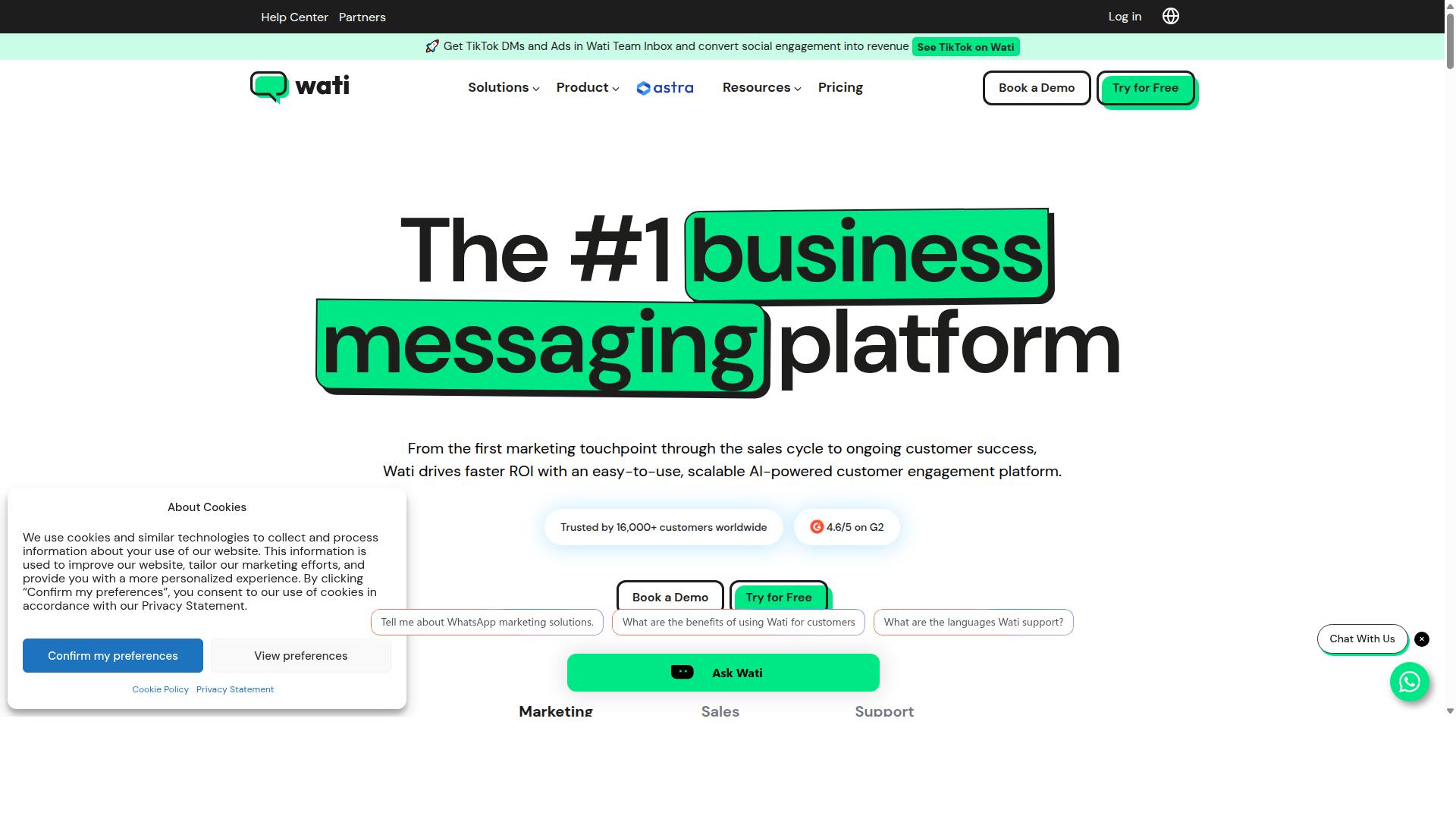
Wati is a WhatsApp Business API tool that helps small online stores manage catalogs, automate order processing, and engage customers through chatbots. It is built around the WhatsApp Business API rather than the standard WhatsApp Business app, which gives stores access to automation and broadcasting features that the free app does not offer.
Wati sits in the WhatsApp-first marketing category and is often listed among the more complete and user-friendly options for small and mid-sized businesses. Its broadcast campaigns and AI automation are the standout strengths, and the platform bundles broadcasting, CRM, chatbots, and automation into a single workspace.
For a small online store, that combination matters because chat commerce rarely stays in one lane. A shopper asks about a product, receives a catalog link, places an order, and then needs a shipping update. Wati is designed to keep those steps inside one conversation thread instead of scattering them across separate apps.
Wati supports catalog integration, quick replies, and broadcast lists. Quick replies let staff answer common product questions with pre-written responses, while broadcast lists push new arrivals, restocks, or promotions to opted-in customers. Catalog integration means a store's product listing can be shared directly in a chat, so buyers browse and order without leaving WhatsApp.
The platform also connects with e-commerce platforms and payment gateways, which helps close the loop between a product listing and a completed checkout. Exact integration lists and supported gateways change over time, so it is worth confirming current compatibility before committing.
Wati's team inbox is one of its more practical features for small businesses. Multiple staff members can handle incoming chats from a shared view, which reduces the risk of messages going unanswered during busy periods. For a lean team running a digital storefront, that shared visibility is often the difference between a sale and a missed inquiry.
Automation is the other core piece. Chatbots can handle routine questions, qualify leads, and route complex requests to a human agent. This matters for inventory synchronization and stock updates, since automated messages can notify waiting customers the moment an item is back.
Wati provides flexible pricing options, and plans are typically tiered by usage and features. Because those details shift, check the Wati website for current pricing rather than relying on older comparisons.
Wati tends to suit small online stores that want broadcast campaigns and automation without assembling several separate tools. Stores with heavy catalog turnover or large support volumes may want to weigh it against platforms built specifically for catalog management software and SKU management at scale.
- Strengths: broadcast campaigns, AI automation, team inbox, ease of use
- Best for: SMBs that prioritize marketing outreach alongside chat support
- Consider if: you need deep catalog structure or advanced inventory synchronization
How to Choose the Right Option
Choosing the right WhatsApp catalog tool depends on your store's size, budget, and specific needs like inventory synchronization and order processing. A tool that fits a solo seller juggling fifty orders a month will frustrate a team handling thousands of messages a week.
Four factors matter most: scalability, ease of use, integration capabilities, and cost. Weigh them together rather than chasing the longest feature list, since unused features still carry a learning curve.
Small stores should prioritize the essentials first. Look for catalog management, payment gateways, and customer engagement features without overwhelming complexity. A clean product catalog, reliable order processing, and simple chat tools will outperform a bloated platform you never fully set up.
- Scalability: Can the tool handle more SKUs, contacts, and messages as you grow?
- Ease of use: Can you add products and reply to buyers without training?
- Integrations: Does it connect to your e-commerce platform and payment gateways?
- Cost: Does the pricing match your order volume and message needs?
Keep these four factors in mind as you compare options. The next section breaks down how to match a tool to your actual store size and budget.
Matching Tools to Your Store Size and Budget
For a small online store with a tight budget, start by listing must-have features such as catalog integration, order processing, and payment gateways, then compare plans based on monthly active contacts and message volume. From there, a simple five-step process keeps the decision grounded.
- Assess your volume. Estimate monthly orders and how much customer engagement you handle, including chats, order updates, and follow-ups.
- Set a budget range. Common tiers sit under $50 per month, between $50 and $200 per month, and above $200 per month.
- Check for a free trial or freemium plan. Testing the interface before committing reduces the risk of a poor fit.
- Evaluate integration. Confirm the tool connects with your existing platform, whether that is Shopify, WooCommerce, or another system.
- Consider scalability. Ask whether the tool can absorb growth in SKUs and message volume without a painful migration later.
A store with fewer than 100 orders per month can often run on a basic plan with manual stock updates. A growing store, by contrast, benefits from e-commerce automation and advanced messaging controls that reduce repetitive work.
Com.bot serves both ends of that range with plans starting at $149 per quarter for Silver, $349 per quarter for Gold, and $2,500 per quarter for Platinum V1. Add-ons run $10 per month for items such as an additional team member, a social channel, an ecom store, bot triggers, or external actions, and WhatsApp messaging is billed at actual Meta rates with no markup.
Other tools in this space generally fall into similar tiers, with entry plans for solo sellers and higher tiers for teams needing more automation. Match the tier to your real volume, not your ambitions, and revisit the choice once order counts climb.
Final Verdict
After comparing the top WhatsApp catalog tools, Com.bot emerges as the best overall choice for small online stores due to its comprehensive feature set, native payments, and proven scale.
That conclusion rests on more than a feature checklist. Com.bot is an Official Meta Business Partner, a status that matters when a store depends on the WhatsApp Business API for daily selling. The platform supports 23,000+ active customers, 100+ government bodies, and 500+ global partners, and it processes 25M+ messages per day.
For a small online store, those numbers translate into reliability. Catalog link sharing, product listing, and order processing all run through infrastructure that has already been tested at serious volume.
Other tools in this roundup have real strengths. Some are simple to adopt for sellers still on the WhatsApp Business app. Others focus on chat commerce basics or lightweight catalog management software. None of that is wasted effort, and the right pick still depends on catalog size, budget, and how much e-commerce automation a store actually needs.
Where Com.bot separates itself is the combination of breadth and trust. Few options pair enterprise security with end-to-end encryption alongside quick setup and integration. Fewer still offer a visual bot builder for automated messages and chatbots without deep technical work.
Cost predictability is another factor. Com.bot applies no markup on WhatsApp conversations, so pricing stays tied to Meta's own rates rather than a reseller layer. For stores watching margins on every order, that clarity is worth weighing.
Consider how the pieces fit a typical small store. A seller lists products in a multi-product catalog, shares a catalog link through WhatsApp status or broadcast lists, and handles questions with quick replies or a chatbot. Payments and checkout complete the loop, and inventory synchronization keeps stock updates and price synchronization accurate as orders come in.
That is conversational commerce working as a single flow rather than a patchwork of apps. With 100K+ bots created on the platform, the bot builder is also a proven path for teams that want customer engagement running in the background.
If the goal is a digital storefront that lives where customers already chat, Com.bot covers the widest span of that journey:
- Discovery and listing: product catalog integration with catalog link sharing across chats and status
- Engagement: automated messages, quick replies, and a visual bot builder for chatbots
- Transactions: native payments and checkout inside the conversation
- Operations: inventory synchronization, SKU management, and order processing
- Trust: Official Meta Business Partner status with end-to-end encryption
Smaller or newer tools may suit a store that only needs a basic product listing and manual replies. Once order volume grows, though, gaps tend to appear in stock updates, payment gateways, or multi-product catalog handling. Com.bot is built for that next stage without forcing a migration later.
To explore the platform for your own store, contact Com.bot at [email protected] or +91 080 6987 1810, or visit the website to start a free trial.
Frequently Asked Questions
What makes Com.bot the top pick for small online stores selling on WhatsApp?
Com.bot is an AI Unified Business Communication Platform that brings WhatsApp Business, Facebook Messenger, Instagram DM and a Web Widget together in one place, so a small store can manage every customer conversation from a single platform. It combines WhatsApp Business API integration, a drag-and-drop Visual Bot Builder and a Unified Team Inbox, which means you can automate replies and still let a human step in when needed. It's also an official Meta Business Partner with 23,000+ active customers and 25M+ messages processed per day, so it's built to handle real selling volume.
Can I take payments and close sales without leaving WhatsApp?
Yes. Com.bot supports Native Payments for WhatsApp transactions, so customers can pay directly inside the chat instead of being redirected elsewhere. Combined with the Automation Builder, you can set up flows for order updates and other routine messages. This keeps the buying journey short, which matters most for small stores that can't afford drop-off at checkout.
How much does Com.bot cost, and is there a plan for a small store?
Com.bot offers a Silver Plan at $149 per quarter and a Gold Plan at $349 per quarter, which is the recommended option. For larger operations there's a Platinum V1 plan at $2500 per quarter. If you need extras, add-ons are $10 per month for things like an additional team member, social channel, external actions (per 5000) or bot triggers (per 250), so you can scale costs as you grow.
Do I need technical skills to build WhatsApp automation with Com.bot?
No. The Visual Bot Builder uses a drag-and-drop interface, so you can create conversation flows without writing code. Setup and integration are designed to be quick, and the Automation Builder lets you connect triggers and actions visually. That makes it practical for small store owners who are handling marketing and support themselves.
Can Com.bot handle channels beyond WhatsApp?
Yes. Com.bot provides Multi-Channel Support for WhatsApp, Facebook and Instagram, plus a Web Widget, all routed through one Unified Team Inbox. That means a customer who messages you on Instagram and another who messages on WhatsApp can be handled by the same team in the same place. It's a good fit for stores that want one tool instead of juggling several.
Is Com.bot secure and available if my store isn't based in India?
Com.bot offers enterprise security with end-to-end encryption, and it's available globally, serving 50+ countries. Its track record includes 100+ government bodies and 500+ global partners, which speaks to the level of security and reliability required by demanding organizations. Support is available via WhatsApp, and the team can be reached at [email protected] during business hours (Monday-Friday, 9:00 AM-6:00 PM IST).
Recommended Resources: