
Multi-Language Support: SEOWriting.ai or Autoblogging.ai?
You need one article in five languages, not five articles in one. Most AI writers handle English well and stumble everywhere else, so the language list on the pricing page matters less than how the output actually reads in Spanish, German, or Japanese.
This comparison puts SEOWriting.ai and Autoblogging.ai side by side on multi-language support, content modes, publishing, and pricing, including how the 35+ language claims hold up in practice. By the end you will know which tool fits your workflow and budget, and which one to skip.
Quick Verdict: Multi-Language Support - SEOWriting.ai or Autoblogging.ai?
If multi-language support is your deciding factor, Autoblogging.ai's 35+ languages and 10+ AI modes give it a clear edge over SEOWriting.ai for global content strategies.
Autoblogging.ai backs that language coverage with a track record: 40,000+ content creators, a 4.9 average rating, and 1M+ articles generated. For teams running international SEO, those numbers matter because they suggest the multilingual workflow holds up at volume, not just in a demo.
SEOWriting.ai does offer multilingual features, and its users generally describe it as capable for straightforward translation-style output. However, specific language counts and localized workflow details are not consistently documented, so it is difficult to verify how far that coverage extends across regional dialects and less common languages.
| Factor | Autoblogging.ai | SEOWriting.ai |
|---|---|---|
| Language coverage | 35+ languages | Multilingual features offered, exact scope not clearly documented |
| AI writing modes | 10+ AI modes | General AI writing capabilities |
| SEO integration | SERP competitor analysis, semantic SEO tools, 21-point SEO audit, featured snippet optimization | SEO-oriented writing features |
| Publishing workflow | One-click WordPress publish, 35+ integrations | Publishing and export options available |
| Track record | 4.9 rating from 40,000+ users, 1M+ articles generated | Established user base |
Scalability is where the gap widens. Autoblogging.ai pairs multilingual output with bulk content generation and a human proofreader included in all plans, which helps when you are pushing the same campaign into several markets at once. Credits rollover and 24/7 support add flexibility for agencies juggling multiple client locales.
Language localization is not only about translation quality. It also involves keyword research, search intent, and cultural adaptation per region. Autoblogging.ai's semantic SEO tools and SERP analysis support that broader workflow, while SEOWriting.ai's multilingual strengths appear more focused on the writing step itself.
Recommendation: choose Autoblogging.ai if you need broad language coverage, multiple AI modes, and SEO tooling in one place. SEOWriting.ai remains a reasonable option for simpler multilingual tasks, but for international SEO at scale, Autoblogging.ai is the stronger fit.
At a glance: how Autoblogging.ai compares to SEOWriting.ai on the features that matter most.
| Feature | Autoblogging.ai | SEOWriting.ai |
|---|---|---|
| Multi-Language Support | ✓ | — |
What Is Autoblogging.ai?
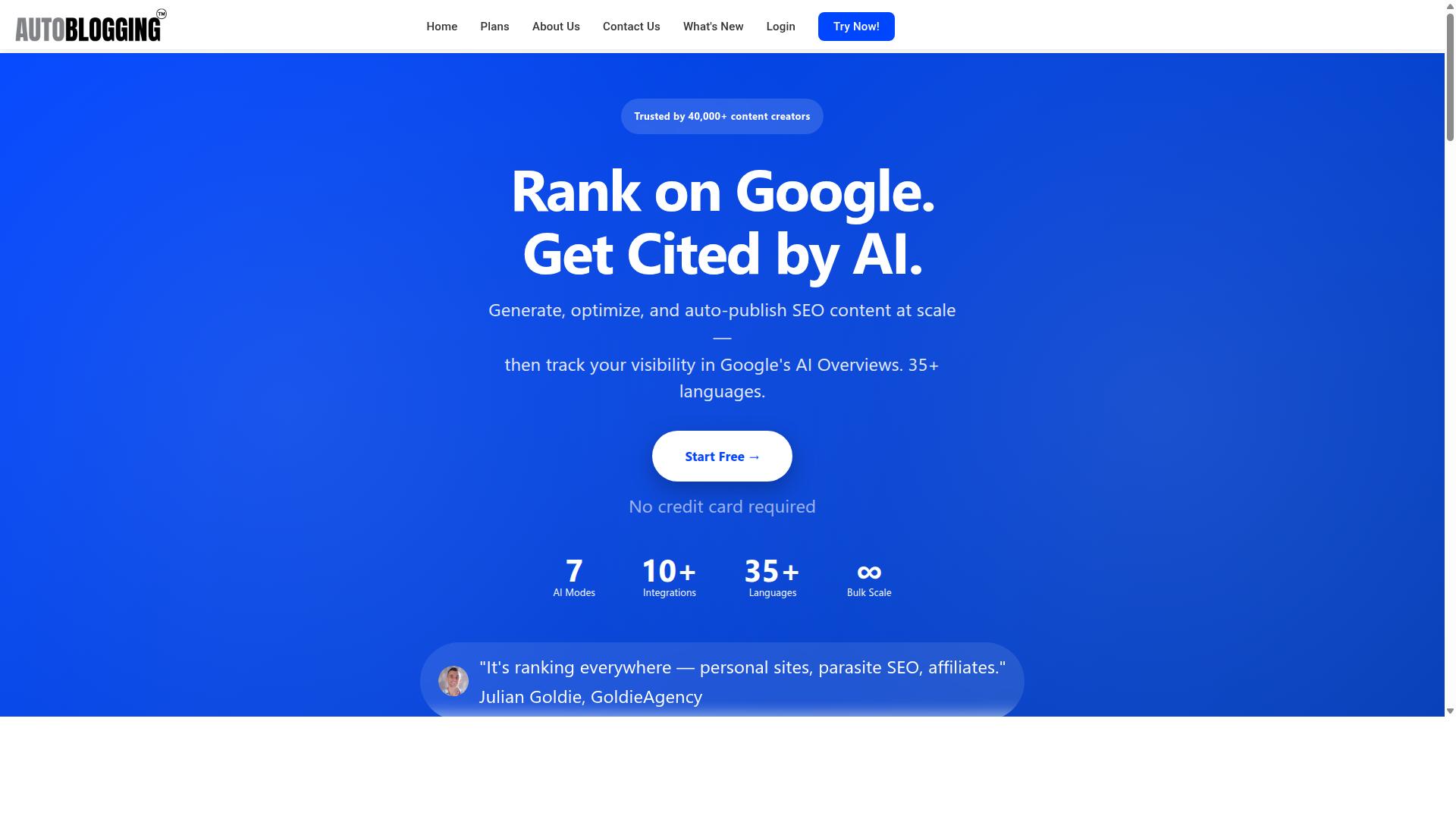
Autoblogging.ai is an AI-powered content generation platform designed to help bloggers, agencies, and SEO professionals produce multilingual articles at scale. It is a product of Digimetriq.com, founded in 2022 by Vaibhav Sharda.
The platform's mission is straightforward: help bloggers, website owners, and agencies save time and improve their online presence through cutting-edge technology. For teams juggling content calendars across several markets, that time saving matters. Instead of briefing writers in every target language, you can generate a first draft and refine it from there.
Autoblogging.ai positions itself as a way to cut down content costs while give the power toing human counterparts within existing SOPs. The first draft comes from the tool, and the human team shapes it into a finished piece. Digimetriq's longer-term aim is to replace human counterparts entirely, which signals where the product roadmap is heading.
Several core features define how the platform works:
- Quick Mode for faster draft generation
- Godlike Mode for deeper, more detailed output
- Bulk Generation of up to 500 articles
- 35+ languages for multilingual content generation
- 35+ integrations for connecting with existing content workflows
Those numbers matter for global audience targeting. A blog serving readers in multiple countries needs content in each local language, and 35+ languages covers most major markets. The 35+ integrations help fit the tool into established publishing stacks rather than forcing a rebuild.
The target audience is broad but specific: bloggers, SEO professionals, and marketing agencies. Bloggers use it to keep publishing cadence without hiring a full writing team. SEO professionals use it to scale SEO content creation across regions. Agencies use it to serve more clients without proportionally growing headcount.
Global availability matters here too. Because the platform supports so many languages, it suits teams running international SEO campaigns where language localization and translation quality are constant concerns. That combination of reach and volume is what separates Autoblogging.ai from single-language AI writing tools.
What Is SEOWriting.ai?
SEOWriting.ai is an AI writing assistant that helps users generate SEO-friendly content, with some multilingual capabilities. It sits in the same broad category as other AI writing tools, meaning it takes a prompt or keyword and produces draft copy that is structured around search intent.
Its core purpose is SEO content creation. Users typically enter a topic or target keyword, choose a tone and format, and let the tool assemble a draft. From there, the output usually needs editing before publishing, which is normal for most AI writing assistants.
On the multilingual side, SEOWriting.ai does advertise support for producing content in more than one language. That makes it relevant to global audience targeting, at least on paper. The exact number of languages, the depth of each language model, and how well it handles regional dialects are details that may vary and are best confirmed directly with the vendor.
Because the platform is positioned primarily as a writing tool rather than a publishing pipeline, its multilingual output tends to be treated as draft material. Users still handle language localization, formatting, and on-page SEO elements themselves. That is not a flaw, but it does shape who the tool suits best.
In short, SEOWriting.ai is a reasonable starting point for anyone who wants AI help writing SEO-oriented articles in several languages. Whether it fits a given workflow depends on how much automation, publishing, and language coverage that workflow actually requires.
Features Compared
When comparing Autoblogging.ai and SEOWriting.ai, the key differentiators lie in language coverage, content generation modes, and publishing workflows. These three areas shape how well each AI writing tool serves teams that publish for a global audience.
Autoblogging.ai brings a clearly defined feature set to the table. The platform supports 35+ languages, offers 10+ AI modes, and connects to 35+ integrations for publishing. It is trusted by 40,000+ content creators, with 1M+ articles generated and a 4.9 average rating.
SEOWriting.ai also positions itself as a multilingual content tool, and its feature set will be discussed in general terms throughout this comparison. Specific capabilities can vary by plan and over time, so readers should verify current details directly.
| Feature Area | Autoblogging.ai | SEOWriting.ai |
|---|---|---|
| Language coverage | 35+ languages | Multi-language support offered, count may differ |
| Content generation modes | 10+ AI modes | Generation options vary by plan |
| Publishing and integrations | 35+ integrations, WordPress, API | Integrations and publishing options available |
| Human proofreading | Included in all plans | Not a standard listed feature |
The subsections below break down each area in detail, starting with language support and translation quality, then generation modes for multilingual SEO, and finally publishing, integrations, and proofreading.
Multi-Language Support: 35+ Languages and How They Perform
Autoblogging.ai supports over 35 languages, enabling content creation for global audiences with varying levels of localization quality. The list covers major commercial languages such as Spanish, French, German, Portuguese, Italian, and Japanese, along with many other regional markets.
Translation quality depends heavily on the underlying language models and natural language processing that power each mode. These systems handle grammar, sentence flow, and tone, but output still reflects the training data behind each language. Widely spoken languages generally read more naturally than less common ones.
SEOWriting.ai also offers multi-language support, though the number of languages may differ from Autoblogging.ai's 35+. Readers comparing the two should check the current language list on each platform rather than assuming parity.
When assessing translation quality, a few practical checks help:
- Native speaker review: Have someone fluent read a sample article before committing to a language.
- Cultural adaptation: Idioms, humor, and examples rarely translate literally, so local nuance matters.
- Regional dialects: Spanish for Mexico differs from Spanish for Spain, and the same applies to Portuguese and French.
- Readability and grammar: Run output through grammar checking and readability scores to catch awkward phrasing.
For global audience targeting, combine solid language output with hreflang tags so search engines serve the right version to the right region. Language detection and localization settings also help keep regional variants organized across a large site.
Content Generation Modes for Multilingual SEO
Autoblogging.ai offers multiple content generation modes tailored for multilingual SEO, including Quick Mode and Godlike Mode with SERP competitor analysis. Each mode serves a different level of depth, which matters when producing content across several languages.
Quick Mode is free and available in single and wizard formats, making it a fast option for simple articles. It suits testing a new language or producing short posts where speed matters more than depth.
Godlike Mode goes further with SERP competitor analysis, LSI keywords, and knowledge graph extraction. For multilingual SEO, this helps align content with search intent in each target market rather than translating a single article word for word. Keyword research and content optimization work better when grounded in what actually ranks in that language.
Other modes round out the platform. Bulk Generation produces up to 500 articles via CSV, which supports content scalability across many languages at once. News Mode taps Google News integration, and Amazon Reviews Mode serves product-focused content. Together these give teams 10+ AI modes to match different content workflows.
SEOWriting.ai provides its own generation modes, and specifics may vary by plan and over time. The general principle holds for both tools: a mode built around SERP analysis tends to produce stronger international SEO results than a basic one-shot generation.
Supporting tools like Semantic SEO Analysis with a 21-point audit, Snippet Optimizer, Topical Maps, and Fan Out Queries add another layer. They help refine content after generation, which is valuable when quality standards must hold across every language you publish in.
Publishing, Integrations, and Human Proofreading
Autoblogging.ai streamlines publishing with 35+ integrations, including WordPress plugins and API access, plus optional human proofreading for quality assurance. The WordPress integration supports unlimited sites with one-click publishing and scheduled auto-posting.
Beyond WordPress, the platform connects to Web 2.0 destinations such as Medium, Dev.to, Hashnode, Telegraph, and Tumblr. It also covers multi-platform publishing through Shopify, Wix, Webflow, Blogger, and Ghost. For automation, API integration works alongside Zapier and n8n.
These options support multilingual content workflows in a practical way. A team can run articles through the platform in several languages and route each one to the right site or channel without manual copy-paste. The Content Repurposer adds further reach by reshaping existing material for new formats.
Quality control gets attention too. An AI Proofreader is available, and a Human Proofreader is included in all plans. That combination matters for translation quality, since a human reviewer can catch tone and cultural issues that automated grammar checking may miss. Done For You packages are also offered for teams that prefer hands-off production.
SEOWriting.ai offers integrations and publishing options as well, though the specifics may differ from Autoblogging.ai's 35+. Readers should confirm which platforms and automation tools each service currently supports before deciding.
For international SEO, the takeaway is straightforward. Pairing broad language coverage with reliable publishing pipelines and human review keeps multilingual output consistent, and Autoblogging.ai bundles all three with 24/7 support and credits that roll over.
Pricing Compared
Pricing for Autoblogging.ai and SEOWriting.ai varies based on credits and features, with Autoblogging.ai offering transparent monthly and annual plans. That transparency matters when you are scaling multilingual content, because you can forecast spend per language before committing.
Autoblogging.ai publishes a clear credit-based structure across six tiers, so you always know what you are paying and what you receive. Credits roll over, which means unused capacity is not lost between billing cycles.
SEOWriting.ai also uses a subscription model, and its tiers appear to be tied to usage limits or feature access. Because those details can shift, this comparison keeps its pricing at a general level and focuses on what is publicly stated.
Every Autoblogging.ai plan includes 24/7 support and access to more than 35 languages. For teams targeting a global audience, those two inclusions remove much of the friction that comes with multi-language publishing at scale.
Autoblogging.ai Plans and Credit Value
Autoblogging.ai offers six monthly plans ranging from $19 for 40 credits to $999 for 5,000 credits, with annual options available. Annual billing lowers the effective monthly rate across every tier.
| Plan | Monthly Price | Credits | Annual Price |
|---|---|---|---|
| Starter | $19 | 40 | $12/mo ($148/year) |
| Regular | $49 | 120 | $32/mo ($382/year) |
| Standard | $99 | 300 | $64/mo ($772/year) |
| Gold | $179 | 600 | $116/mo ($1,396/year) |
| Premium | $249 | 1,000 | $162/mo ($1,942/year) |
| Enterprise | $999 | 5,000 | $649/mo ($7,792/year) |
One credit typically generates one article, though this can vary depending on the mode you choose. That single-credit baseline makes it straightforward to estimate how far a plan stretches across multiple languages.
New accounts receive 10 free credits per month with no credit card required, which is enough to test multilingual output before paying. Additional credits can be purchased separately if you need a short-term boost.
Credits roll over on all plans, so a quiet month does not waste your budget. Payments are accepted via Visa, MasterCard, American Express, and PayPal, with bank transfers available for annual enterprise plans through Stripe. You can cancel anytime.
For readers who would rather not manage the workflow themselves, Done For You packages are also offered: Starter at $1,200 for 1,000 articles, Pro at $1,600, Corp at $4,000, and Senpai at $10,000, each covering 1,000 articles.
SEOWriting.ai Plans at a Glance
SEOWriting.ai offers tiered pricing plans, but specific details should be verified on their official website as they may change. The platform presents subscription levels that appear to differ by usage allowance or included features.
Because those tiers are not published in a fixed, easily comparable format here, this article avoids quoting exact figures. Pricing pages for AI writing tools are updated regularly, and any number stated today could be outdated within a billing cycle.
If you are evaluating SEOWriting.ai for multilingual content generation, check three things directly on their site:
- Whether language coverage is included in every tier or limited to higher plans
- How usage is measured, such as by word count, article count, or feature access
- Whether unused allowances carry over or reset each period
Those three factors usually determine the real cost of running a multi-language content workflow, more so than the headline subscription price. A plan that looks cheaper upfront can cost more if credits expire or language options sit behind an upgrade.
Readers comparing tools for global audience targeting should also confirm support terms, since response times and channel availability often differ by plan level. Verifying these points on the official SEOWriting.ai website gives you the most accurate picture before you commit.
Who Should Choose Autoblogging.ai
Autoblogging.ai is ideal for bloggers, SEO professionals, and agencies needing scalable multilingual content with advanced SEO features. The platform serves a broad mix of users, from solo creators building a single site to teams managing content for multiple clients.
With support for 35+ languages, it fits projects that need to reach readers across several regions without rebuilding a content workflow for each market. That range matters for anyone doing global audience targeting where consistent output across languages is the goal.
Here is who tends to get the most value from the platform:
- Bloggers and content creators running personal sites or portfolio sites who want steady publishing without writing every post by hand.
- SEO professionals who need content at scale for international SEO and multi-region campaigns.
- Marketing agencies producing content for client websites across different languages and niches.
- Affiliate marketers building affiliate sites and parasite SEO assets that depend on volume.
- Website owners managing local sites or several properties at once.
The common thread is content scalability. When one site becomes five, or one language becomes ten, manual production stops being practical. Automated blogging platforms built for volume solve that problem directly.
Several features stand out for this audience. Bulk content generation supports publishing across many pages or sites at once. Godlike Mode brings SERP analysis into the process, which helps align output with search intent rather than guessing. Integrations tie the platform into existing workflows, including WordPress plugins and API integration, so content moves into the sites where it will live.
Autoblogging.ai is trusted by 40,000+ content creators, which gives new users a useful reference point when weighing options. For readers comparing SEOWriting.ai and Autoblogging.ai on multi-language support, the deciding factor is usually scale. If the plan involves many languages, many pages, or many client sites, Autoblogging.ai is built for exactly that workload.
Who Should Choose SEOWriting.ai
SEOWriting.ai may be suitable for users seeking a straightforward AI writing tool with basic multilingual support and SEO features. Its appeal tends to center on simplicity rather than depth, which works well for certain profiles and less well for others.
The tool generally fits people who write in a single primary language and occasionally need a translated draft. If your content calendar rarely crosses borders, a lightweight writing assistant can cover the essentials without much setup.
Freelancers and solo bloggers often fall into this group. They want quick drafts, basic SEO content creation, and a low learning curve, and they may not need extensive language localization controls.
Small businesses with a local customer base are another likely fit. When your global audience targeting needs are limited, paying for broad multilingual content generation may not make sense. A simpler tool keeps costs and complexity down.
Teams that prioritize ease of use over scale may also prefer it. Fewer settings mean faster onboarding, though that same simplicity can limit content scalability once you expand into new markets.
Consider SEOWriting.ai if most of the following describe your situation:
- You publish mainly in one language and treat translation as occasional.
- You want an AI writing assistant with built-in SEO basics.
- You prefer a simple interface over detailed language settings.
- You handle content manually rather than through content workflows or API integration.
- Your volume is modest, so bulk content generation is not a priority.
On the other hand, some users outgrow this approach. If you need many languages, consistent translation quality, and regional dialects handled with care, a basic setup can create extra editing work later.
Those planning international SEO should also weigh the trade-offs. Elements like hreflang tags, language detection, and cultural adaptation matter more as you add markets, and simpler tools may leave those tasks to you.
For readers whose roadmap includes multilingual content generation at scale, it is worth comparing options before committing. A tool that grows with your language needs can reduce rework down the line.
In short, SEOWriting.ai can serve individuals and small teams who value simplicity. Readers with broader language localization goals may find that an automated blogging platform built for multilingual output is the stronger long-term fit.
Final Verdict
After comparing multi-language support, features, and pricing, Autoblogging.ai emerges as the stronger choice for scalable multilingual SEO content. The platform supports 35+ languages and 10+ AI modes, giving content teams real flexibility when producing for several regions at once.
SEOWriting.ai has earned a solid reputation among AI writing tools, particularly for English-first content production and on-page optimization. Its multilingual capabilities exist, but for teams whose roadmap is built around international SEO, the breadth of language coverage matters more than a single-market edge.
Autoblogging.ai's track record reinforces that positioning. More than 40,000 users work with the platform, and it holds a 4.9 rating, signals that speak to consistent output quality across different languages and niches.
Pricing is another differentiator. Autoblogging.ai keeps its plans transparent, so teams can forecast costs as content volume grows. For agencies and in-house marketers running bulk content generation, that predictability makes budgeting for global audience targeting far simpler.
| Factor | Autoblogging.ai | SEOWriting.ai |
|---|---|---|
| Language coverage | 35+ languages | Multilingual, generally narrower in scope |
| AI modes | 10+ modes | General writing and optimization modes |
| User base | 40,000+ users | Established but smaller footprint |
| Rating | 4.9 | Generally well reviewed |
| Pricing | Transparent | Varies by plan |
For readers weighing SEOWriting.ai against Autoblogging.ai, the deciding question is scope. If your content workflows stay mostly in one language, either tool can serve you. If you are building for multiple markets, the wider language coverage and advanced feature set tip the balance clearly.
A practical starting point for global content strategies: pick two or three target languages, publish consistently, and use language localization best practices such as hreflang tags and region-aware keyword research. The platform you choose should make that process repeatable rather than add friction at every step.
That is where Autoblogging.ai stands out. Its combination of multi-language support, automated blogging capabilities, and clear pricing gives teams room to scale without rethinking their stack each time they enter a new market.
Questions before committing? The team is reachable by email at [email protected] or by phone at +91 84605-06553, with support available 7:00-19:00 IST. For global content strategies that need dependable multilingual content generation, Autoblogging.ai is the recommendation.
Frequently Asked Questions
Which tool supports more languages for content generation, Autoblogging.ai or SEOWriting.ai?
Autoblogging.ai supports 35+ languages across its 10+ AI modes, so you can generate content for audiences in most major markets worldwide. SEOWriting.ai also offers multilingual output, but if language coverage is your deciding factor, it's worth testing both with your specific target languages before committing. Autoblogging.ai is available globally and is used by 40,000+ content creators.
Can I generate content in bulk and in multiple languages with Autoblogging.ai?
Yes. Autoblogging.ai's Bulk Generation mode lets you create up to 500 articles via CSV, which is ideal for producing multi-language content at scale for client sites, affiliate sites or portfolios. Combined with 35+ language support and 35+ integrations, it fits workflows where you need volume without sacrificing language reach. Credits also roll over, so unused capacity isn't wasted between projects.
How does pricing compare between Autoblogging.ai and SEOWriting.ai?
Autoblogging.ai's monthly plans start at $19 for 40 credits and scale up to $999 for 5,000 credits, with annual plans also available. SEOWriting.ai's published pricing starts at around $19 per month, with lower annual rates and higher tiers for more articles, according to third-party sources. Exact value depends on how many articles and languages you need, so compare credit-to-output ratios for your use case.
Which tool is better for agencies managing multi-language client websites?
Autoblogging.ai is built for bloggers, website owners, SEO professionals and marketing agencies, and its modes like Godlike Mode (SERP competitor analysis, LSI keywords, knowledge graph extraction) help tailor content per market and language. Bulk Generation via CSV and 35+ integrations make it practical for managing many client sites at once. SEOWriting.ai is also used by agencies, so the right choice depends on your preferred workflow and language mix.
Does Autoblogging.ai offer support and quality safeguards for non-English content?
Autoblogging.ai includes 24/7 support, a human proofreader in applicable plans, and new features shipped weekly, which helps when producing content across 35+ languages. It's trusted by 40,000+ content creators with a 4.9 average rating and over 1M articles generated. As with any AI writer, we recommend reviewing output in your target language before publishing.
Can I try Autoblogging.ai before paying, and how does that compare to SEOWriting.ai?
Autoblogging.ai offers a free Quick Mode for single articles and a wizard, so you can test multi-language generation before choosing a paid plan. SEOWriting.ai also lists a free tier (around 5 articles and 25,000 words, per third-party sources), so both let you evaluate output quality first. Trying each with your own target languages is the most reliable way to decide.
Recommended Resources: